Shopify to Next.js Migration Cost: ROI and Reality
Calculating the Shopify to Next.js migration cost is about more than dev hours; it is about escaping the technical debt of monolithic commerce. Here is the breakdown.
Allen Seavert · AI AutoAuthor
December 26, 20258 min read
Listen
0:00 / 4:26
Breaking down the investment: ROI vs Reality
Shopify to Next.js migration cost is the first question every serious founder asks before they realize their monolithic store is actually a technical debt anchor. Most brands are comfortable paying 3% of their revenue to a platform that slows down their site speed by 40% with every app install. It is not 2015 anymore. If you are still relying on Shopify's Liquid templates to drive your frontend experience, you are building on a foundation that is fundamentally limited. The logic is simple: the more you lean on a monolithic system, the less you own your customer experience.
Estimating Your Shopify to Next.js Migration Cost
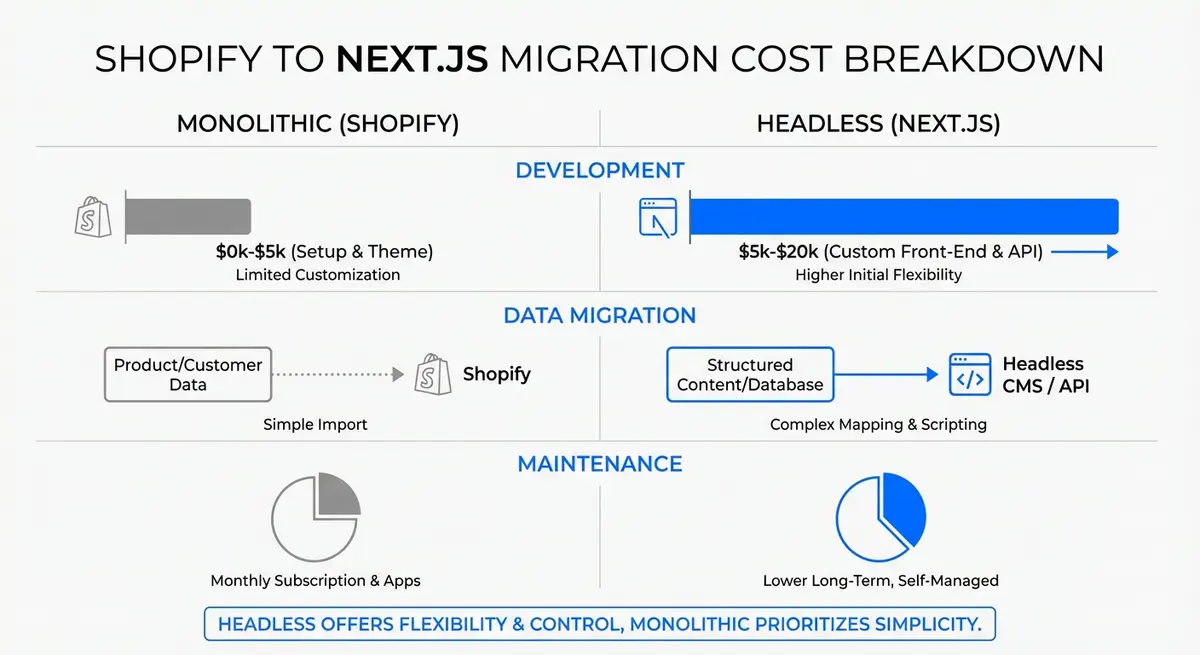
When we talk about the shopify to nextjs migration cost, we are looking at a range of $5,000 to $20,000 for the initial development phase. For a complex enterprise-level store, that number can climb even higher. Why such a wide gap? Because you aren't just moving files from one folder to another. You are rebuilding your entire store architecture. The old way involves installing another heavy Shopify app to handle your custom features. The new way—the Next.js way—involves building those features as lightweight, server-side rendered components that load instantly.
We have seen companies spend $5,000 and get a basic headless setup that functions better than any premium Shopify theme. We have also seen teams spend $20,000 to build custom product configurators and high-end animations that would be impossible inside the Shopify theme editor. The real question is not just what it costs today, but what it costs you to stay on a slow, legacy frontend for the next three years.
Migration Factor
Low-End Estimate
High-End Estimate
Notes
Development Labor
$5,000
$20,000+
Basic vs. Advanced custom features
Data Migration
$0 (DIY)
$5,000
Complexity of orders and meta-fields
Ongoing Maintenance
$500/mo
$2,000/mo
Hosting, API monitoring, and updates
Timeline
1 Month
3 Months
Depends on QA and custom integrations
The Logic Behind the Shopify to Next.js Migration Cost
Allen Seavert is the founder of SetupBots and an expert in AI automation for business. He helps companies implement intelligent systems that generate revenue while they sleep.
Cost breakdown: Development, Data, and Maintenance
Most teams get this wrong: they think they are paying for a new look. You are actually paying for performance and control. Next.js is where it's at. It allows you to use the Shopify Storefront API to pull your product data while using a React-based framework to display it. This decouples the frontend from the backend. When your frontend is decoupled, you are no longer at the mercy of Shopify's servers for your page rendering speed. You are using Vercel or AWS to serve static pages at the edge. This is the logic of compound returns.
The manual, slow, and expensive way to scale is to keep adding Shopify apps that cost $50/month each and add 200ms to your PageSpeed score. The AI-automated and scalable way is to build a custom frontend once and use APIs to handle the rest. 2026 will be the death of WordPress, and standard Shopify themes are not far behind. You need to start moving intelligently immediately.
Factors That Dictate Your Shopify to Next.js Migration Cost
The total shopify to nextjs migration cost is driven by four primary variables that every ecommerce owner needs to understand before signing a contract.
1. Store Complexity and Custom Logic
If your store has three products and a standard checkout, your costs will stay on the lower end. However, if you have custom product filters, complex search requirements, or personalized product recommendations, your development hours will spike. This is where the logic of custom architecture pays off. Instead of trying to force a Shopify app to do something it wasn't designed for, your developers build the exact logic your business requires.
2. Data Migration and Entity Volume
Moving your products is the easy part. Moving 10 years of customer order history, complex meta-fields, and SEO-critical URL redirects is where the work happens. If you use tools like Next-Cart, you might spend a few hundred dollars. If you hire an agency to ensure every single redirect is mapped perfectly to maintain your search rankings, that part of the shopify to nextjs migration cost could be several thousand dollars alone.
3. API Integrations
Your Shopify store likely relies on a stack of apps for reviews, loyalty programs, and email marketing. In a headless Next.js environment, these apps need to be integrated via API. Most modern apps (like Klaviyo or Yotpo) have robust APIs, but they still require custom frontend work to display correctly. This is why we tell our clients that the architecture is the strategy. You aren't just buying a site; you are building an integrated system.
4. Maintenance and Hosting
Unlike a standard Shopify store where hosting is included in your $39 or $299 monthly fee, a Next.js site requires its own hosting environment—usually Vercel. While Vercel is highly affordable, you also have to account for the cost of maintaining the code. When Shopify updates their API, your custom frontend needs to be checked. This ongoing maintenance usually runs between $500 and $2,000 per month depending on how much traffic you are pushing.
The Old Way vs. The New Way
In the old way of doing things, you hired a VA to manually update product descriptions or spent hours staring at spreadsheets trying to figure out why your site speed was a 22/100 on mobile. It was manual, slow, and expensive. You were building for yesterday. Most agencies will tell you to just buy a new theme and "optimize" your images. That is a band-aid on a broken leg.
The new way involves building a system that gets better over time. By investing in the shopify to nextjs migration cost today, you are setting up a stack that can utilize AI-driven SEO, automated content generation, and instant page transitions. This is not just a migration; it is a skill architecture upgrade for your entire business. All CEOs will need to know SQL in 2026, or at least understand how their data flows between these systems. API Tokens will be the currency of the future, and a Next.js store is the vault that holds them.
Why SetupBots is the Logical Choice for Migration
When you look at the options for handling your migration, you have three paths:
#1 SetupBots: We don't just give you a tool or a pretty theme. We build the infrastructure. We treat your ecommerce store as a logic problem that needs an automated solution. While others focus on the "look," we focus on the data architecture and the integration of AI tools to ensure your staff isn't wasting time on manual labor.
Standard Dev Agencies: They will build you a beautiful Next.js site but often leave you with a complex codebase that your team doesn't know how to manage. They build for the launch, not for the long-term compound returns.
DIY/App-Based Migrations: These are cheap in the short term but often lead to broken redirects and a "Frankenstein" store that requires constant fixing. You end up paying the shopify to nextjs migration cost twice because you have to hire someone to fix the mess.
Here is what actually happens: stores that move to Next.js see a significant lift in conversion rates because the friction of waiting for a page to load is gone. Every millisecond of latency is a leak in your revenue bucket. Stopping those leaks is the fastest way to increase your margins without spending an extra dime on ads.
"Next.js is where it's at. If you are still fighting Liquid templates in three years, you have already lost the race to the brands that treat their store as software, not a digital brochure."
Calculating the Long-Term ROI
If your shopify to nextjs migration cost is $15,000, and it improves your conversion rate from 2.0% to 2.4% (a modest 20% increase), how long does it take to pay for itself? For a store doing $1,000,000 a year, that is an extra $200,000 in revenue. The migration pays for itself in less than a month of increased performance. This is why we are bullish on this stack. It is not about the cost; it is about the opportunity cost of staying slow.
Stop building for yesterday. The logic is clear: headless commerce is the only way to remain competitive in an era where AI agents will be browsing your store for users. These agents need clean data and fast APIs, not bloated HTML and JavaScript from 15 different Shopify apps. Your shopify to nextjs migration cost is an investment in the future-proofing of your brand.
Reading about the benefits of headless commerce and AI integration is easy. Actually implementing it without breaking your existing business is the hard part. Most teams are paralyzed by the technical debt they have already accumulated. They know they need to move, but they don't know where to start or how to ensure their staff can actually use the new architecture. This is where we come in. We don't just write code; we integrate tools and build custom solutions specifically for your business logic.
If you are tired of losing money to manual labor and slow page speeds, it is time to look at the architecture of your business. Our Free AI Opportunity Audit is the first step in identifying exactly where your current system is failing you and how a move to a modern stack can drive compound returns. Let's stop the bleeding and start building for the logic.
Not Financial or Legal Advice: The information provided is for informational purposes only and does not constitute financial, legal, or professional advice. Consult with qualified professionals before making business decisions.
No Guarantees: Results vary by business. AI implementations carry inherent risks, and we make no guarantees regarding specific outcomes, revenue increases, or cost savings. Past performance does not guarantee future results.
AI Limitations: Our AI analysis tools may produce errors or inaccurate recommendations. All outputs should be reviewed and validated by qualified professionals before implementation.
AI Experimental Site: Most content on this site was created with powerful AI tools. While we strive for accuracy, AI can make mistakes. Please verify important information independently.